Hot-Swappable, Gasket-Mounted, and Full of It: Decoding the Jargon Keyboard Brands Use to Empty Your Wallet
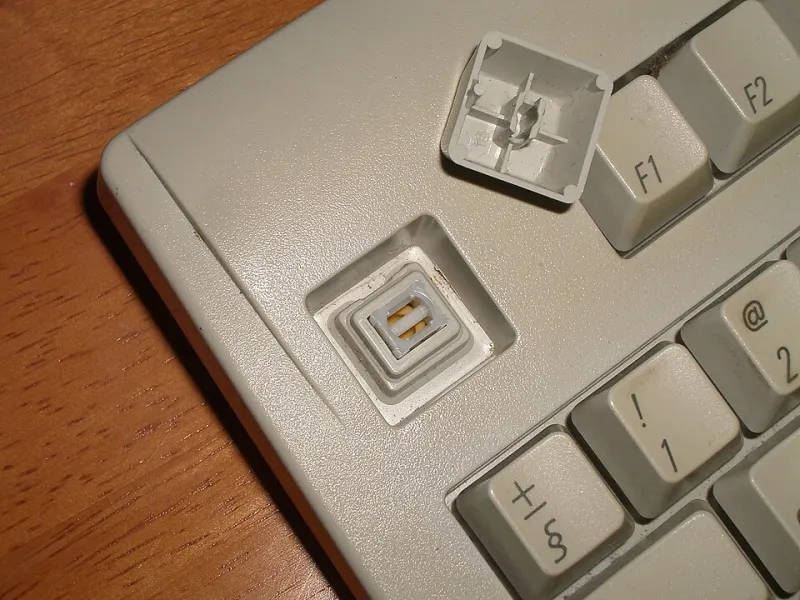
Photo: Daniel beardsmore, Public domain, via Wikimedia Commons
Somewhere along the way, buying a keyboard started sounding like ordering wine. 'Ah yes, the gasket mount really lets the plate breathe.' 'Mmm, notes of pre-travel and a long, satisfying finish.' Meanwhile, half these $180 boards contain the same switches as the $45 one sitting in your shopping cart, and the difference is mostly marketing departments discovering the word 'artisanal.'
We're not anti-fancy-keyboard here at BananaPC. We're anti-nonsense. So let's sort the specs that matter from the specs that exist to justify a price tag.
'Mechanical' Means Less Than You Think
'Mechanical' is the biggest technicality in tech marketing. It just means each key has an individual switch with a physical actuation mechanism — as opposed to a membrane sheet. That's it. It says nothing about quality. A $30 mechanical board with mushy, rattly off-brand switches is technically mechanical in the same way a banana is technically a berry. Accurate, but misleading at parties.
What actually matters is which switches. Cherry MX-style linears (Reds), tactiles (Browns), and clickies (Blues) have decades of clones with wildly different quality. The switch name on the box tells you almost nothing; the brand behind it tells you a little more; reviews with a force curve graph tell you everything.
Hot-Swap: The One Feature Worth Paying For
If there's a single spec that genuinely changes ownership value, it's hot-swappable sockets. Being able to pull switches out and replace them without a soldering iron means your board can evolve — go linear for gaming, tactile for typing, and never buy a new PCB because your tastes changed.
It's also the feature that's cheapest to implement, which is why it drives us bananas when budget boards ship without it and $170 boards act like they invented it. Hot-swap should be table stakes under $80. If it's not, ask why.
Gasket Mount: Real, But Overhyped
Here's the honest take: gasket mounting — where the plate is sandwiched in foam rather than screwed directly to the case — does measurably soften the typing feel and dampen sound. It's real engineering.
It's also used to explain away $60 price jumps on boards where the 'gasket' is a strip of foam you could replicate with a mousepad and scissors. If a brand leads with gasket mount and says nothing about switch quality or stabilizer rattle, they're selling you a buzzword. A great switch on a tray-mount board beats a mediocre switch on a gasket every time.
Optical Switches: A Solution Looking for Your Money
Optical switches use a light beam instead of metal contact to register a press. The pitch is speed — faster actuation, no debounce delay. The reality is that for 99% of gamers, the difference is unmeasurable at human reaction speeds, and the ecosystem lock-in is real: many optical boards don't accept standard MX switches, so you're married to the manufacturer's parts forever.
Unless you're a competitive player who genuinely benefits from rapid-trigger features (which are legitimately excellent on Hall-effect boards), optical is a premium tax dressed up as innovation.
The $150 Board With $12 Internals
The dirty secret of the premium keyboard market: PCBs are cheap. Cases are cheap. The price is in the perceived quality — the weight, the finish, the branding, the limited colorway collab. Some flagship boards from major gaming brands use switch components functionally identical to what ships on entry-level boards, then charge triple for aluminum and a nice coiled cable.
That's not always a scam — build quality and software matter. But check the specs that are hard to fake: genuine stabilizers (rattly spacebar stabilizers are the tell of a lazy board), PBT keycaps instead of shiny ABS, and 1,000Hz polling that's actually implemented.
What to Actually Buy
Hunt for: hot-swappable PCB, reputable switches (Gateron, Kailh, and Cherry are all fine at various prices), PBT caps, and decent stabilizers. Skip: optical lock-in, 'mechanical feel' membrane boards, and any marketing that uses the word 'immersive' more than twice.
Your fingers will know the difference. Your wallet will thank you. And if anyone asks, yes — the gasket mount really lets the plate breathe. Wink.